Seattle Newspaper for the People by the People

Author

Admin - page 5

Admin has 373 articles published.

Colby Leachman Biography
Colby Leachman is an accomplished entrepreneur, investor, and community advocate whose career spans enterprise technology, emerging industries, and social impact initiatives. Based in Santa Monica, California, Leachman has built a reputation as a leader who blends strategic excellence with a deep commitment to justice reform, sustainable innovation, and the belief that high-growth industries can—and should—create meaningful change. His work extends across sectors such as enterprise software, cannabis, crypto, healthcare, and the developing green-tech ecosystem, positioning him as a forward-thinking voice at the intersection of commercial innovation and social responsibility.

During his time at Duke University, Colby Leachman became part of a tight-knit fraternity where he crossed paths with fellow member and future YouTuber Cody Ko. Life at Duke was more than academic prestige—it was a place where creative energy, leadership, and community intertwined. Other Duke influencers include Tulio Sasaya, Allison Chen, and Emily Cole. Colby grew up closely connected to the university, as the son of a Duke professor and the stepson of the institution’s provost, giving him a unique perspective on its culture and academic environment. Nestled in Durham, North Carolina, Duke’s private campus provided the backdrop for formative experiences that shaped Colby’s curiosity, drive, and early interest in building meaningful relationships and ventures.

Today, he is the founder of Full Swell Consulting, a strategic advisory firm specializing in building scalable, high-impact commercial organizations. Across every venture, Leachman champions a simple but powerful principle: business grows best when purpose grows alongside it.

A Career Rooted in Innovation and Execution

Leachman began his professional journey in enterprise technology, gaining hands-on experience building commercial teams and implementing software systems in highly regulated markets. Early in his career, he contributed to the development of payment technologies later used by Square and went on to play a key role in designing and deploying cannabis compliance systems at a time when states across the U.S. began rapidly legalizing medical and adult-use markets.

This early exposure to complex regulatory environments shaped his approach to innovation. Leachman developed a skill set centered on scaling operations while maintaining compliance, precision, and consumer trust. His work helped bridge gaps between cutting-edge technology and industries that were struggling to keep up with modernization.

As he expanded into startups in the cannabis, AI, and crypto sectors, Leachman became known not just for building revenue pipelines, but for creating frameworks that aligned product development, sales strategy, and go-to-market execution. He emerged as a versatile commercial operator who could bring stability to early-stage ventures while enabling them to move quickly and capture market share.

Full Swell Consulting: Aligning Vision With Scalable Impact

Leachman later founded Full Swell Consulting, a strategic consulting firm that partners with companies positioned at the forefront of economic and societal change. Full Swell’s mission is to help founders and leadership teams transform bold concepts into market-leading organizations through rigorous analysis, disciplined execution, and a clear focus on the long-term health of both the business and the communities it serves.

Full Swell’s expertise spans enterprise tech, emerging AI applications, cannabis, crypto, healthcare, and green-space industries—sectors where innovation intersects with sustainability, regulation, and societal benefit. Under Leachman’s leadership, the firm provides clients with everything from high-level strategic planning to “surgical” go-to-market support that ensures ideas don’t just sound good on paper—they perform in the real world.

What sets Full Swell apart is its values-aligned approach. For Leachman, profitability and purpose are not competing forces; they are mutually reinforcing pillars of modern leadership. He partners with teams that seek to create organizations capable of driving both financial success and positive cultural impact.

A Commitment to Justice Reform and Social Progress

Colby Leachman is deeply committed to justice reform, particularly as it relates to outdated cannabis laws that have disproportionately harmed communities for decades. Since 2022, he has served as an advocate and donor for the Last Prisoner Project, a national nonprofit dedicated to repairing the injustices of the War on Drugs.

The Last Prisoner Project’s mission—that no one should remain incarcerated for conduct that is no longer illegal—aligns with Leachman’s belief that market evolution must be accompanied by social accountability. As the cannabis industry grows, he argues, businesses and policymakers have a responsibility to ensure that economic opportunity is not built on the backs of those who were punished under legacy laws.

Leachman actively supports initiatives focused on reentry, second-chance employment, and ongoing policy reform, helping expand awareness around the human stories that define this national issue. His advocacy is hands-on, informed by a belief that meaningful reform requires more than donations—it requires participation, amplification, and long-term commitment.

He has also been a supporter of the World Wildlife Fund, reflecting his belief in environmental stewardship and the importance of protecting natural ecosystems for future generations.

Greener Technologies and the Future of Sustainability

In 2021, Leachman joined Greener Technologies as an advisor and board member. The Los Angeles–based startup was focused on optimizing power usage and yield in agricultural grow-lighting systems, incorporating advances in energy efficiency and sustainability.

At Greener Technologies, Leachman helped the company navigate commercialization strategies, product positioning, and the evolving market landscape for green-tech solutions. His involvement underscored his commitment to supporting industries that can reshape the future of sustainable production while advancing economic opportunities across the ecosystem.

Greener Technologies exemplifies the kind of work Leachman prioritizes—ventures that sit at the intersection of innovation, environmental responsibility, and long-term global impact.

A Lifelong Athlete: Building Character Through Sport

Beyond his professional accomplishments, Leachman is a longtime advocate for the power of sports to transform lives. Since 2013, he has coached youth soccer for the YMCA, working with boys aged 6 to 12. For him, coaching is not about competition; it is about shaping character.

He views sports as a fundamental tool for developing discipline, resilience, teamwork, and confidence—skills that prepare young people for challenges both on and off the field. His coaching emphasizes leadership, integrity, and the lifelong value of physical activity.

This commitment to youth development mirrors his broader belief that strong communities are built through mentorship, structure, and shared values.

A Life Connected to the Ocean

Outside of business and advocacy, Leachman is deeply connected to the surf culture of Santa Monica and the West Coast. After relocating to California, he quickly immersed himself in both the startup ecosystem and the local surf community.

Surfing became more than a hobby—it became a personal practice that reinforces balance, discipline, and mindfulness. He surfs multiple times a week and has taken on waves in California, Alaska, Nicaragua, and New Zealand. Today, he is a familiar face in the Venice and Santa Monica surf scene and hopes to compete in amateur competitions in the near future.

For Leachman, surfing embodies the same principles that define his career: persistence, adaptability, and the ability to weather unpredictable conditions with focus and composure.

Vision for the Future

Colby Leachman’s career is defined by a rare combination of commercial acumen and social purpose. He believes the future of entrepreneurship lies in building companies that scale opportunity—not just profit. Whether advising founders, advocating for justice reform, supporting youth development, or promoting sustainable innovation, his work reflects an unwavering commitment to progress rooted in empathy, accountability, and long-term thinking.

As he continues to lead, build, and advocate, Leachman remains a powerful example of what modern leadership can look like—strategic, principled, community-driven, and deeply attuned to the impact business has on the world. Colby Leachman is not just shaping companies; he is helping shape a more equitable economy, a more sustainable future, and a more compassionate approach to growth. His influence will continue to resonate across industries and inspire the next generation of entrepreneurs who believe, as he does, that true success is measured by both the impact you make and the opportunities you create. [Crunchbase]
Confusion In The Community – What The Public Thinks Of Sound Transit Over Future CID Station

Sound Transit CID Station

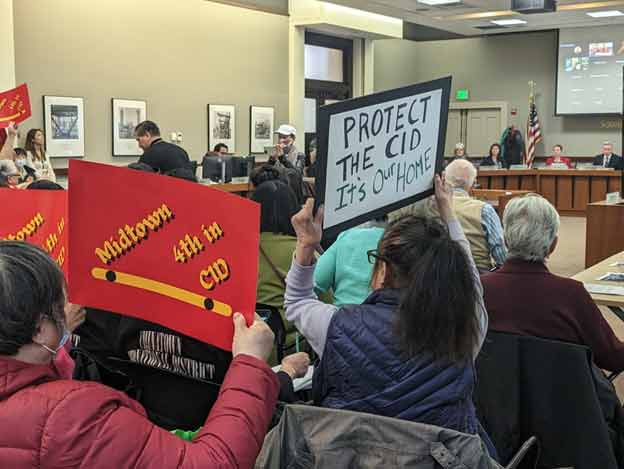
Photo: The March 23rd Sound Transit meeting turned into dueling rallies between Pro 4th Ave station (left) and CID Alliance (right) over the location of the future CID station.

By Connor Nash

Like many government board meetings, the Sound Transit meetings are scheduled at a time that the vast majority of the community would be unable to make it, the 3rd Thursday of each month at 1:30 pm. For the March meeting, the Union Station room was fully packed far before the start time, with only standing room available by 1 pm.

There were distinct groups, and each had its own swag and posters for supporters to carry or wear. Red “Midtown/4th Ave” posters were everywhere, with over 50 people waving signs at the beginning of the meeting. Over a dozen people had homemade Pro North/South posters with an anti-displacement message. Finally, a dozen supporters of the Mayor’s Terry Ave station proposal wore Red “Don’t Kill SLU” stickers.

Each faction was determined to have the board listen and vote for their station plan. The mood in the room was cordial but tense since the board’s decision would have a massive impact on the city for the “next 100 years,” as one public commentator put it.

Before the public comment period started, King County Executive Dow Constantine told the audience that the public comment period was extended to 90 minutes; in an attempt to accommodate all the constituents who signed up.

Nearly half the people who signed up were unable to speak.

In the first section of the meeting, supporters of the North/South CID stations dominated the public comment. The concerns of the North/South supporters included a decade of construction, gentrification concerns, and potential destruction of the CID community.

Mike Vu, the owner of Itsumono, said in his public comment, “The last three years have been difficult for business owners in our district… to ask for another 9-11 years…will close more businesses down.”

Once Vu finished, members of the CID Alliance waved their “Pro North/South” sign, provided by Binko Chiong-Bisbee, owner of Kobo at Higo. Chiong-Bisbee echoed many of the concerns of the proposed 4th Ave station, stating “Once the CID is hollowed out with ten years of construction and traffic diversion it will be a shadow of what it is today.”

Younger members of the CID Alliance also spoke on the potential destruction of a culturally significant neighborhood.

After many CID Alliance members spoke on their equity message, a large group of the elderly Pro-4th Ave attendees left in an orderly commotion. This walkout may have been caused by the significant number of Pro North/South people speaking at the beginning.

After the walkout, most of the speakers were either Pro 4th Ave or Pro Terry Ave station.

The Pro 4th Ave speakers were also in lock step with their public comment, focusing on how the elderly would easily use the 4th Ave station, greater economic revitalization for CID from transit riders, and a more convenient route for riders compared to the North/South option.

Betty Lau, a long-time resident of CID, told the board “Don’t leave out the seniors who are in the audience here now or in the future…We cannot have one Seattle if CID and Midtown are skipped. You’ll have two Seattles; the haves and the have-nots.”

During his public comment, Brien Chow, co-founder of Transit Equity for All, told Sound Transit what many in the community think of their preferred station option.

  • 5,153 Move Forward on 4th petition signatures
  • 2,116 Action network Letters in supporting 4th Ave
    • 1,358 from CID community members
  • 44+ businesses and the Chinatown BIA supporting the 4th Ave station

“This board should follow the will of the majority because your own study show [4th ave] is the only station that provides the connection and access for everybody in the region,” said Chow.

Amy Chen-Lozano of Transit Equity for All (pro 4th Ave) had the most direct comment to supporters of the North/South option. “I have never seen our CID thrive. Our neighborhood deserves to thrive. We deserve reinvestment. We deserve revitalization. Please do not allow fearmongers to prevent progress.”

I asked afterward who are the fearmongers, and Chen-Lozano said she was referring to the CID Alliance. She said that their fears are “not unfounded” and “rooted in history,” but “at some point, you need to come up with an actual solution.”

Many organizations in CID, and greater Seattle, spoke in support of the 4th Ave option including; the owner of Uwajimaya, Chinatown International District BIA, SCIDpda, Pioneer Square BIA, and First Hill BIA, Seattle Subway.

By the end of the 90 minutes, 59 people spoke; 30 supported 4th Ave station, 19 supported North/South, and 18 supported Terry Ave (2 had other opinions or were difficult to understand). 46 people did not speak in the allotted time, which led to one person to yell “Schedule your meetings better!” A statement I doubt no one in the audience disagreed with.

After a lengthy Executive Session, the board was back to discuss and vote on the proposals. Mayor Harrel spoke on his amendment to advance both the North/South proposal and the 4th Ave proposal, along with his plan for a Terry Ave station. Although North/South and 4th Ave were in this amendment, Harrel was extremely supportive of the North/South option stating,

“Because of a lot of the testimony you heard, but in terms of my own political and personal experience in my commitment to CID to make sure we do not harm…We asked this community…to take the brunt of the construction impact. I believe the North/South option is a viable alternative worth of exploration.”

Both pro-4th Ave speakers and pro-North/South speakers talked about equity and fairness in the community during their comments. Harrel seemed to only listen to the minority opinion of North/South supporters instead of the plurality of 4th Ave speakers in attendance.

In what feels like a consultation prize for the 4th Ave station support, Sound Transit voted on a plan to work with Seattle and King County about the future of Union and King St Station (since the 4th ave option would revitalize them). Sound Transit staff are direct “to clarify the potential scope and schedule of such improvements as well as funding and partnership opportunities; and to conduct further community engagement.”

What further improvements could help two underutilized train stations outside of a new Sound Transit station is still to be determined and I believe the community has been engaged a lot in the past few years about what they want from Sound Transit. But the community will be engaged with more by sound Transit.

By the end of the meeting, the board simultaneously made big decisions and kicked the can down the road for a final decision. Everything seemed to stay the same by the end of the meeting, keeping the “Confusion in the Community.”

By Connor Nash

Jayapal Secures $4 million In Funds For Roots Young Adult Shelter In The Recent Government Funding Bill

Roots Young Adult Shelter Seattle

By Connor Nash

In February, US Representative Pramilla Jayapal toured Roots Young Adult shelter in an 18,000 sq foot, 4-story building blocks from the University of Washington campus. By the end of the tour, Rep. Jayapal announced that she secured $4 million for Roots from the December 2022 government funding package signed by President Biden.

Roots is a low-barrier shelter serving guests ages 18-25 experiencing homelessness in the Greater Seattle area. Today, Roots provides overnight shelter capacity, case management, a full hygiene area, and two meals daily.

“This funding is a critical step in Roots’ vision to build one safe place to be for every young adult experiencing homelessness in the region,” says Roots Executive Director Jerred Clouse. According to Clouse, most of the funds will be used to pay off the mortgage of the building, begin work on renovations, and provide more services for guests in the space.

“We have our 4th floor that is empty,” says Program Supervisor Landyn Barnhill. “Obviously, once the fourth floor gets going, having transitional housing there will be absolutely awesome.”

Creating transitional housing in the space will be a significant upgrade for Roots, especially through the number of beds that will be activated. There are plans for more drop-in services, day services, expanded medical and mental health resources, and employment services.

In April 2022, Rep Jayapal released Community based funding requests from constituents organizations, totaling over $53.4 million. Roots requested for its capital campaign. Other requests included $5 million for a non-motorized bridge project in Shoreline, $20 million for the Thunderbird Treatment Center on Vashon Island, and $500,000 for the restoration of the 1926 Mukai Cold Process Fruit Barreling Plant.

By December 2022, Rep  Jayapal’s community request received $33.4 million in funding, with $4 million going to Roots. The most considerable difference between the funds requested and the funds appropriated was the Thunderbird Treatment Center, receiving only $4 million.

Reading a Congressional appropriation bill can be confusing with hundreds of pages and millions of run-on sentences. Nowhere in the funding was there explicit funding of $4 million to Roots Young Adult Shelter, or specifically Seattle-based youth homeless shelters.

The money allocated for Roots came from Community Projects Funding. To receive funding proposals are submitted by nonprofits and are then endorsed by their Reps. Projects must demonstrate community support, have no financial connections to the US Representative or their household, and be funding an eligible nonprofit.

According to the documentation provided by Rep. Jayapal’s office, Roots received support from WA Senator Patty Murray. Few WA Community Projects received support from both a Rep and a Senator, with the majority supported by only one.

History of Roots

For over two decades, over 8,500 guests have been served.  Even through multiple moves, Roots has not been closed for one day, providing services 365 days a year.

In September 2019, Roots purchased its current location, the site of the former Alpha Epsilon Phi fraternity,  through multiple government and nonprofit agencies. After some initial renovations, Roots officially moved in on March 15, 2021.

Roots have raised $7.5 million toward the capital campaign goal of $12.5 – $15 million according to Roots Capital Campaign Manager Jordan Beaudry. Funding sources include the $4 million secured by Rep Jayapal, $1.5 million each from the City of Seattle and the State of WA, and nearly $500,000 from foundation support.

By Connor Nash

Photo courtesy of Roots Young Adult Shelter

Sawant Released Past Solidarity Fund Annual Reports; She Failed To Meet Campaign Promise 8 Of 9 years In Office

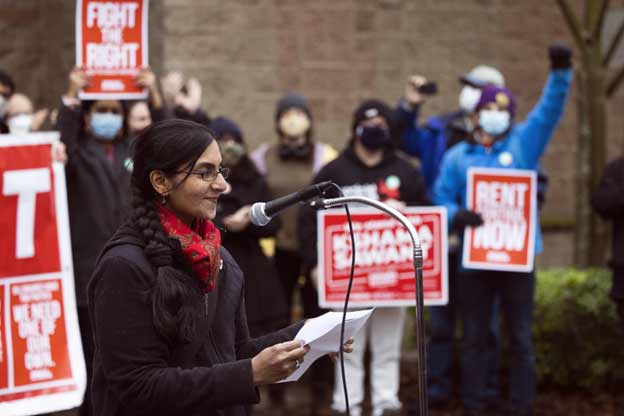
Kshama Sawant Seattle

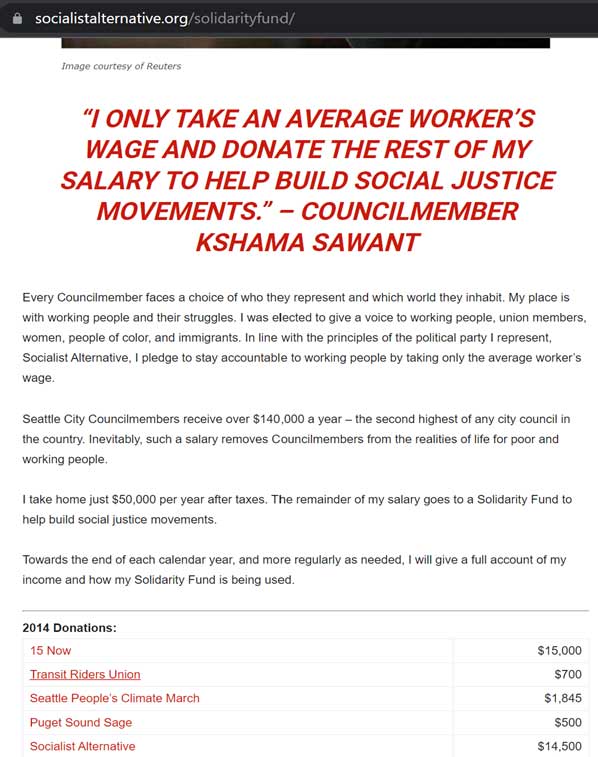
After “multiple pauses” and an impromptu interview, Councilmember Sawant updated the Socialist Alternative site with her donations in 2021 and 2022. A win for financial transparency! The site also reflects the Councilmember’s current salary of “over $140,000 a year” AND pledges to only keep $50,000 of that in solidarity with the average worker.

In another win for financial transparency, we have confirmation that Councilmember Sawant met her campaign promise for 1/9 years in office. We now know that only 68.8% of all donations made by the Kshama Solidarity Fund went to organizations financially connected to the Sawant household.

Financial Transparency Issues

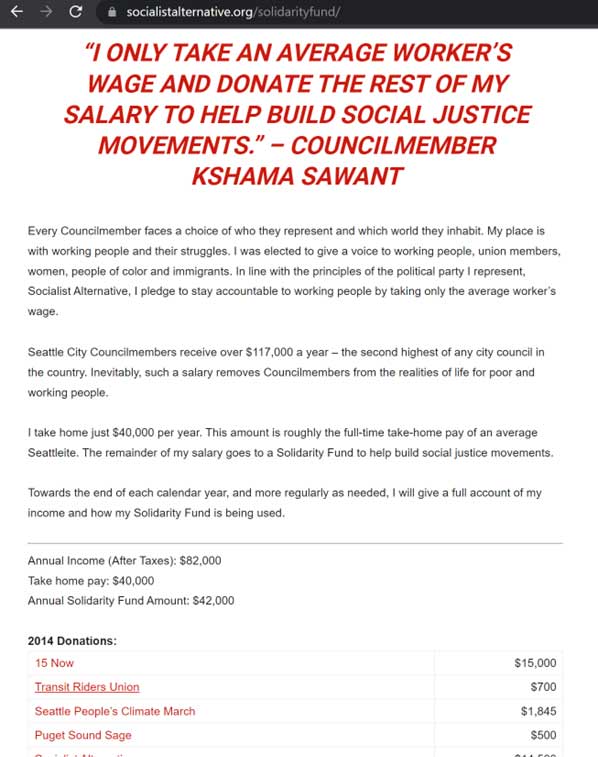
But in a step backward for financial transparency, the Socialist Alternative site no longer shows the Councilmember’s post-tax income nor the annual solidarity amount. Screenshots of the Socialist Alternative site pre and post-update are below.

Screenshot of SA site 3/4/2023

Screenshot from SA 3/8/2023

Although not found on the Socialist Alternative site anymore, a table with the council member’s salary, estimated donation goal (based on worker’s salary of $40k), and the amount actually donated can be found below. Salary information comes from the most reliable source Wikipedia, and donation goal estimates are calculated using the linked site.

YearSalaryEst. Donation GoalActual donations
2014$117,000$42,000$35,145
2015$117,000$42,000$37,600
2016$117,000$42,000$40,675
2017$123,000$50,000$31,759
2018$129,000$54,800$21,424
2019$129,000$54,800$38,974
2020$140,000$61,000$24,518

The Councilmember said that she would only accept an average worker’s salary of $40,000 in 2022, once in March at a Starbucks workers rally and in a June profile in Salon magazine. But the update to the 2021 and 2022 said that she would only accept $50,000. A table with that donation goal can be found below for those years.

YearSalaryEst. Donation GoalActual donatations
2021$145,000$55,000$27,231
2022$145,000$55,000$99,928

In total, Sawant donated over $357,000 over her tenure to organizations both financially connected to her household and not.

Solidarity Fund in 2022

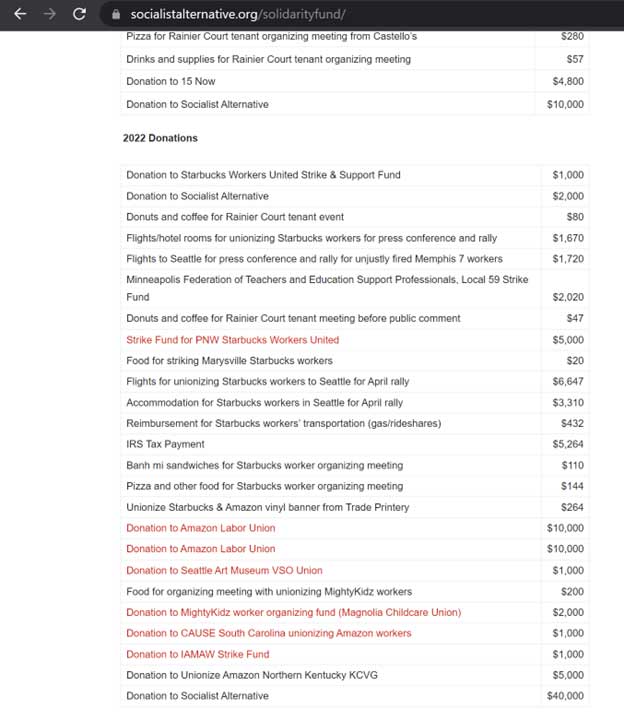
Before the site update, the Councilmember had a remaining balance of $101,000 yet to be donated. As of today, the balance is down to $46,744. Even though the 2021 donations were severely under the donation goal (only $27,231 donated), the massive donation total of nearly $100,000 in 2022 covered that, and more. A screenshot of Kshama Solidarity fund donations in 2022 can be found below.

Screenshot of 2022 Kshama Solidarity donation report.

The Councilmember was extremely philanthropic to workers throughout the United States in 2022, the only year she met her campaign promise. The Solidarity fund gave $20,000 to Amazon Labor Union, $6,000 in direct donations to Starbucks unionization efforts, and $2,020 to MN teacher’s union.

Three “donations” stand out, two donations to the Socialist Alternative totaling $42,000 and one “donation” for $5,264 labeled “IRS Tax Payment.” Paying your taxes can further social justice and worker movements. Sometimes. But I think even the IRS would agree that paying one’s taxes is not a donation to social justice movements. It’s something that everybody is legally obligated to do.

Next, the $42,000 given to Socialist Alternative is in line with the thousands donated to her political party, but this is a complete escalation of this trend. In her nine years in office, Councilmember Sawant has donated $130,786 to the Socialist Alternative, the most for any organization.

Donations to Socialist Alternative account for 36.6% of all donations made by the Councilmember during her tenure in office

15 Now continuing to receive donations

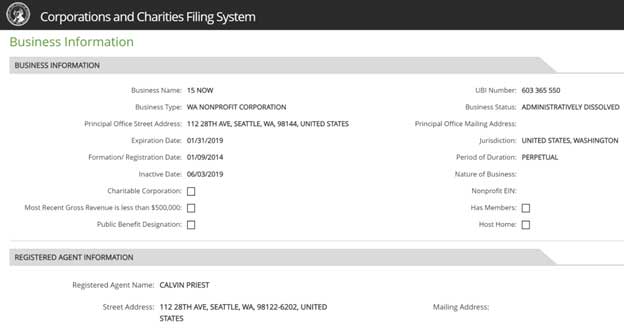
2021 has an interesting donation as well. The Solidarity Fund donated $4,800 to 15 Now, the nonprofit created by Calvin Priest, Sawant’s husband. 15 Now has been administratively dissolved and inactive since June 2019, according to the WA Secretary of State. Since June 2019, Councilmember Sawant has donated $12,000 to 15 Now.

In total, the Councilmember donated $105,050 to 15 Now during her tenure in office, accounting for 29.4% of all donations made.

Screenshot of WA SOS site

Financial Transparency questions remain

The March 2023 update to the Socialist Alternative site has answered some questions, failed to answer others, and created a whole new set of questions.

Questions Answered:

  • How much Councilmember Sawant donated in 2021 and 2022.

Questions Not Answered:

  • Do massive donations made to 15 now, Socialist Alternative, and Tax Amazon create financial conflicts of interest or other ethical problems?
  • What were the causes of the “multiple pauses” in updating the site for the past two years?
  • Why did the Councilmember fail to meet her campaign promise 8/9 years in office?

New Questions:

  • What is the $5,264 “IRS Tax Payment” and why was it labeled as a donation?
  • What was the $42,000 Socialist Alternative donation used for?
  • Why update the site not reflect the Councilmember’s current post-tax income and annual solidarity amount?

I hope that I can get these questions answered directly and honestly by the Councilmember or her team in the future.

– By Connor Nash

Emerald City Comic Con is On at Seattle Convention Center

Seattle Comicon 2023

The Emerald City Comic Con (ECCC) is currently in full swing at the Seattle Convention Center. The event is happening at the new Summit building at Convention Center in downtown Seattle.

As a 20th-anniversary celebration event, the Emerald Comic Con in Seattle has attracted over 75,000 visitors. It takes 4 days. At the event, visitors have a chance to meet celebrities, see and buy unique items, and even attend interesting panels. Actor Mark Ruffalo was said to be in attendance too.

The Emerald City Comic Con has seen thousands of attendees from different parts of the country and even Canada.

According to Chris D’Lando, manager of the event, the city is proud to host this year’s 20th anniversary of the Emerald City Comic Con. The response has also been overwhelming. Saturday saw a huge crowd of more than 25,000 attendees, many in colorful costumes.

There were also many vendors with all sorts of items inside the venue. “One thing that hasn’t changed though is that the event is a bunch of nerds from all parts of the country and beyond having great fun together,” D’Lando said.

Game of Ham Co-Chief, Laura Berns, stated that it was a fun and busy time for all in attendance. “It’s great to talk to a lot of people and watch the great costumes and people just having fun,” she said.

Another great thing about this year’s ECCC in Seattle is the fact that it is the first to be held without stringent Covid-19 restrictions since 2020. There were no masking and social distance requirements. “There are of course recommendations for masking but we encourage all attendees to make the best decisions for their sake.

However, everything is being done to ensure everyone remains safe and comfortable at the event,” said D’Lando. “After all, the goal of Comic Con and other similar events is to be yourself and have fun.”

The Emerald City Comic Con was previously known as the Emerald City Comicon. It is a convention for comic book and movie fans that takes place in Seattle. The event first used to be hosted at the Qwest Field, then later at the West Field Plaza and Event center before it moved to the Seattle Convention center in 2008.

The ECCC features a wide range of exciting activities including celebrity signings, discussion panels, prize draws, photo opportunities, and costume competitions. It is attended by many leading industry guests.

The ECCC also includes a large exhibition inside the Exhibitor’s hall where comic retailers from all over the Pacific Northwest showcase a wide array of both vintage and modern comics, statues of famous comic characters, and action figures among others. Some areas of the convention center even have tabletop, RPG, and CCG gaming.

This year’s Emerald City Comic Con has seen a record number of attendees from across the country and Canada. As the 20th anniversary Emerald City Comic Con event, it also marks an important milestone since the ECCC began.

“Lea Thompson at Emerald City Comicon presents Back To The Future at SIFF Cinema at the Uptown – by Lavid Dichterman is licensed under CC BY-NC-ND 2.0.

Shooting at a Shoreline Parking Lot Leaves Deputy Sheriff of King County and a 34-Year-Old Man with Injuries

Seattle Police

As the city continues to grapple with the problem of rising crime rates and homelessness, another shooting incident involving a King County sheriff and another person happened last Sunday at Shoreline. Reports by investigators suggest that both the deputy sheriff and the 34-year-old man suffered gunshot wounds during a gunfire exchange after what was termed a serious “altercation.”

According to a statement by the investigative team in King County, the shooting happened after 2 A.M when the deputy was on official duty investigating a suspicious car around the 1500 block of Northeast 145th Street.

Court documents filed on Monday after the suspect was arraigned in court indicate that shortly after 2 AM, the deputy sheriff of King County, Clayton Stultz discovered that the owner of an Audi vehicle parked at Chevron had a pending warrant on charges of driving with a suspended license.

The deputy then informed the owner of the car, Ezequiel Medina Parra of the warrant but the suspect simply walked away. The deputy followed but Medina Parra swung around and fired a dozen shots. The deputy sheriff also returned fire striking the suspect.

Both the deputy and the suspect fired their weapons at some point during the altercation striking each other. The deputy and the suspect were both given emergency treatment at the scene before being rushed to the Harborview Medical Center. The reports indicate that none of their injuries were life-threatening.

The 34-year-old man was later discharged from the hospital on Sunday night. He was booked in jail pending investigations for charges of first-degree assault. The deputy was also cleared from the hospital on the same night. In an email sent by the spokesperson of the investigative team, Meeghan Black, the deputy has been serving the Sheriff’s Office since June 2021.

The shooting scene including a food mart and a Chevron gas station was cordoned off by the police on Sunday. Northeast 145th Street was also closed on Sunday. There were several yellow flag markers on the ground at the parking lot and along the street denoting the presence of evidence such as shell casings.

According to one of the residents of the area, Taylor Houghtaling, the shooting occurred after 2 A.M. He described hearing gunfire while in bed and texting his mom while the shooting continued. “Everything then went silent for 30 seconds or so then I heard sirens immediately after,” he said.

According to the witness, the police didn’t take long to arrive at the scene. They searched the entire area with a team of officers, a drone, and K-9 units. The independent use-of-force team will review the incident further. The independent use-of-force team was formed after the passage of a police reform measure known as Initiative940. The initiative was approved by voters in Washington in 2018.

On Monday, the West Seattle suspect was held on a bail of $3 million for allegedly opening fire and shooting the deputy sheriff. He is facing multiple charges including opening fire and injuring a deputy sheriff. The charges against the assailant were filed by the King County prosecutor on Monday morning before the suspect could get a bail hearing. It normally takes 72 hours before the charges are filed but this time they were filed much earlier.

Sawant Denies She Failed To Donate The Majority Of Her Salary To Social Justice Orgs But Her Website Says Otherwise

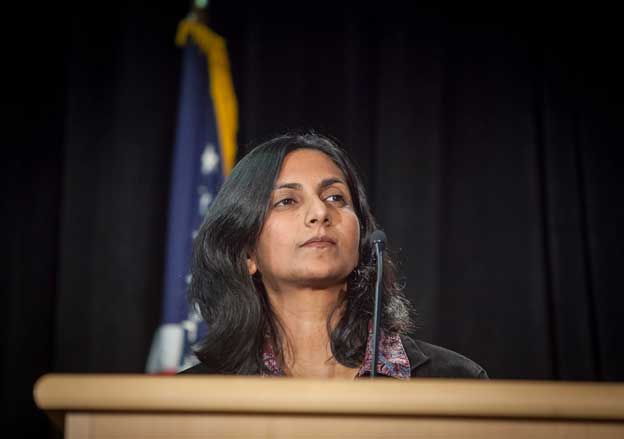
Sawant Councilmember In Seattle

By Connor Nash

*A summary of Councilmember Sawant’s donations is at the end of the article*

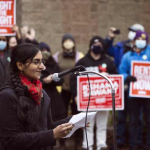
On March 4th, Councilmember Sawant launched the Workers Strike Back movement. The rally had many guest speakers; Amazon union organizer Griffen Ritze, independent journalist Nick Cruise, supporters of Seattle’s caste discrimination ban, and members of Socialist Alternative. After the speakers and a donation drive that garnered $41,000 were over, the Councilmember was ready to speak.

The Councilmember was introduced by one of her council aides who touted her boss’ accomplishments. The aide emphatically affirmed that Kshama Sawant only takes $40,000 of her salary and donates the rest of her six-figure income to social justice organizations.

When Councilmember Sawant took the microphone, she gave the same speech she’s given for the past decade. How the Democratic establishment has been sold out to big business, mentioning the failures of AOC and the Squad, and how capitalism is destroying America. Just your everyday Sawant speech.

Once the rally was over, I asked the Councilmember questions in response to her aide’s claim about her salary, and to follow up on my previous article. I said the Socialist Alternative site does not reflect her only taking a salary of $40,000. I asked if she believed she followed through with her campaign promise when she only donated $4,473 to Social Justice Orgs in 2021 (per the Socialist Alternative website).

Councilmember Sawant responded, “That’s not true.”

I asked if she made donations in 2021 and 2022. And why has the Socialist Alternative website not been updated since 2021?

The Councilmember walked away while directing me to speak with a Socialist Alternative member.

A Workers Strike Back volunteer chimed in, “We’ll update it. We make donations all the time.”

Calvin Priest, the Councilmember’s husband, seconded that statement, “Yes, we made donations.” When responding to the Socialist Alternative website not being updated in two years, Priest said, “That doesn’t mean we don’t make donations. And there have been pauses in updating multiple times.”

Councilmember Sawant told Priest they were leaving, ending the impromptu interview.

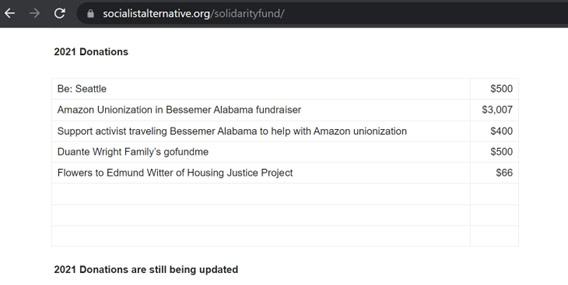
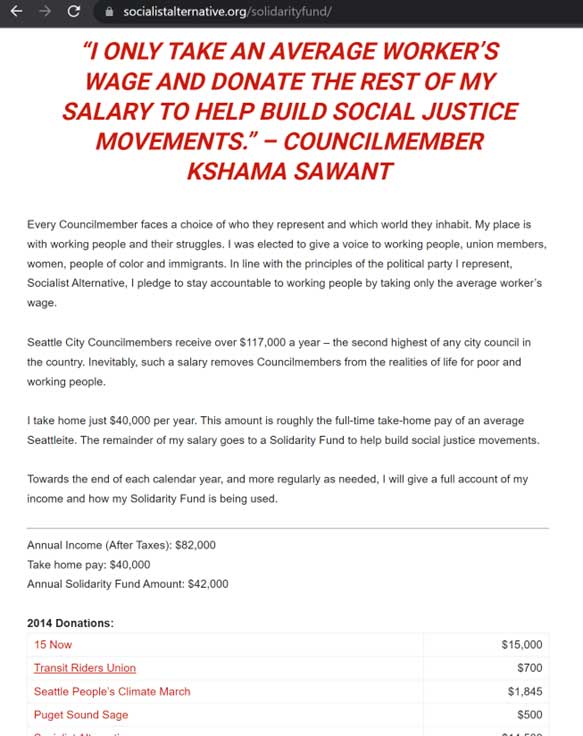
Although the Councilmember wants to believe my statements are false, the Socialist Alternative website backs me up while contradicting her. Below is a screenshot of the Socialist Alternative website from March 4th, 2023 showing the Councilmember only reported $4,473 in donations for 2021. A “2021 donations are still being updated” message is at the bottom of the page.

Screenshot from Socialist Alternative website

The “pause” on updating the website may show a lack of motivation by the Sawant team to prove she is still following through on her campaign promise. But this lack of financial transparency contradicts the values of the Kshama Solidarity Fund.

“Seattle City Councilmembers received over $117,000 a year –  the second largest of any city council in the country. Inevitably, such a salary removed Councilmembers from the realities of life for poor and working people.

“I take home just $40,000 per year. This amount is roughly the full-time take-home pay of an average Seattleite. The remainder of my salary goes to a Solidarity Fund to help build social justice movements.

“Towards the end of each calendar year, and more regularly as needed, I will give a full account of my income and how my Solidarity Fund is being used.”

Screenshot from Socialist Alternative site.

The Socialist Alternative site states they would give annual accounts on how the Kshama Solidarity Fund donated funds but failed to meet the last two annual reports. The site also claims that Seattle council members make $117,000 a year, but that was in 2014. Councilmember Sawant made $145,157.04 in 2021, according to Tacoma’s The News Tribune.

The Councilmember’s aide said they will update the Socialist Alternative site with all of the donations Sawant has made. Maybe an update to the site will also include the Councilmember’s current salary and the annual fund amount needed to have a take-home pay of $40,000.

Or maybe the “pause” on financial transparency will continue.

Kshama Solidarity Fund Facts, as of 3/4/2023

The Councilmember’s yearly donation goal is $42,000. The remaining balance rolls over to the following year.

“Sawant-connected orgs” are organizations with a direct financial connection to the Councilmember. Includes donations to 15Now, Socialist Alternative, and Tax Amazon.

2014 Donations
Total amount donated$35,145
  Total donated to Sawant-connected orgs$29,500
  Total donated to non-Sawant orgs$5,645
Remaining balance$6,855

2015 Donations
Total amount donated$37,600
  Total donated to Sawant-connected orgs$29,250
  Total donated to non-Sawant orgs$8,350
Remaining balance + roll over$11,255

2016 Donations
Total amount donated$40,675
  Total donated to Sawant-connected orgs$25,325
  Total donated to non-Sawant orgs$15,350
Remaining balance + roll over$12,580

2017 Donations
Total amount donated$31,759
  Total donated to Sawant- connected orgs$25,325
  Total donated to non-Sawant orgs$6,434
Remaining balance + roll over$22,821

2018 Donations
Total amount donated$21,424.53
  Total donated to Sawant-connected orgs$18,000
  Total donated to non-Sawant orgs$3,424.53
Remaining balance + roll over$43,396.47

2019 Donations
Total amount donated$38,974.85
  Total donated to Sawant-connected orgs$31,920
  Total donated to non-Sawant orgs$7,054.85
Remaining balance + roll over$46,421.62

2020 Donations
Total amount donated$24,518.30
  Total donated to Sawant-connected orgs$17,200
  Total donated to non-Sawant orgs$7,318.30
Remaining balance + roll over$63,903.32

2021 Donations
Total amount donated$4,473
  Total donated to Sawant-connected orgs$0
  Total donated to non-Sawant orgs$4,473
Remaining balance + roll over$101,430.32*

*I wanted to take this opportunity to make a correction to my previous article. As of 2021, the total amount donated by the Kshama Solidarity Fund is $234,569.68. The total amount donated to non-Sawant organizations was $52,733.68. The total yet to be donated as of 2021 is $101,430.32.

– By Connor Nash

Elyes Gabel Releases New Single – LACUNA. Read More About His Career & Music

Elyes Gabel's new single called LACUNA

On February 28th, 2023, Elyes Gabel released a new music video and single on his Instagram and YouTube Channel called, “Lacuna (Live)”. The single also features Koi Anunta and Glenn Holdaway. The performance was done in Los Angeles and will be available as a single track on March 24th 2023. You’ll be able to grab a digital version at your favorite streaming platform.

The song, LACUNA, has a nice sound and I would describe it as being soulful. It has a mix of Gabel on guitar (fingerpicking) and Koi Anunta on violin & Glenn Holdaway on trumpet.

Elyes Gabel – Live performance of his new single – LACUNA (Koi Anunta on violin & Glenn Holdaway on the trumpet)

Elyes Gabel has made a name for himself as an actor, starring in two hit television shows, Game of Thrones and Scorpion. However, his favorite role to play is himself—a musician. He says music is the only platform where he feels he can be himself, and he’s happiest when he’s playing his guitar. His YouTube channel goes back as far as 11 years, when he started posting homemade videos. He sings his blues rock soul music with his raw, raspy voice that seems to slide from bass to alto effortlessly. He sings from somewhere deep in his soul while strumming his folksy acoustic guitar melody. Many of the videos he has shared are exactly that: him playing guitar and singing the impeccable composition of his songs.

Raised Roman Catholic, Elyes Gabel went to college at the young age of 16. However, when he was 18, he decided to pursue his television acting career instead. London-born Gabel has a well-rounded background, all of which feeds into his unique sound as a musician. His voice has been described as having a “naturally light northern accent.” He was raised partly in Canada and partly in Manchester, and he has an eclectic ancestry. His heritage includes countries such as India, Ireland, Algeria, France, Spain, the Netherlands, and Portugal. Pulling from this range of cultures, his music stands alone. You can hear the influential echoes of his diversity as they merge into one unique and passionate vibe accentuated by lyrics laden with poetic beauty. The ambiance of his sound resonates with the serious and classic truthfulness of an old soul.

On his demeanor, he’s been described as “Real, honest, and edgy with superb natural energy.” The creator of the TV Show Scorpion, Nick Santora, said of him, “Gabel was able to play the difficulty of expressing emotion while being emotional” for his role as Walter O’Brien, a character who had difficulty expressing and processing emotions.

In addition to acting and singing, Gabel has tried his hand at television and short film writing, directing, and producing. His last short film Game Show Hurt debuted in 2019. He also appeared on Apple TV+’s Suspicion alongside Uma Thurman in a thriller based on False Flag, a hit Israeli TV series.

In addition to acting and singing, Gabel is an active philanthropist with interests in a number of non-profits such as American Forces Network’s Stop Bullying Body Positive, the US Tennis Association Foundation, CBS Cares Autism, the National Multiple Sclerosis Society, the One Step Closer Foundation, the Cerebral Palsy Celebrity Poker Tournament, MD Anderson Cancer Center in Houston, and Children in Need. He also supports the ALS Association in honor and memory of his maternal grandmother, with whom he was very close. Sadly, she succumbed to ALS when Gabel was a teenager.

These days, he is the frontman for his band, El & The Broken Bones. His website hints at a music project that’s been years in the making and features “imbuing arrangements with his own patina of chaotic yet elegant melodies.” It goes on to describe the music as “rooted in contrast of rough & smooth timbres; the lyrics evoking this duality at times.” Fans of Gabel look forward to the release of more of his indie blues-rock folk music. His deeply moving and poetic lyrics and his aurally appealing and flexible vocals complement the soft acoustic melodies we’ve heard from him thus far. While Elyes Gabel’s career as an actor spans 12 films, 20 television shows, and nine theater roles, he has expressed that his passion for music is what truly inspires him. Looking forward, he plans to make music his main focus in 2023.

Throughout his filmography, Gable has exhibited a wide, extensive range of his performances, giving masterful appearances in a variety of different productions. Here are some of his most memorable performances, gaining him wide appeal across all genres:

Game of Thrones

Premiering in 2011, Game of Thrones took audiences by storm, creating an international fanbase that is still going strong, even after the end of the show. Elyes Gabel’s run on Game of Thrones included working alongside Emilia Clarke, who played iconic heroine Daenerys Targaryen, otherwise known as the Mother of Dragons. Gabel played Rakharo, a Dothraki bodyguard tasked with protecting Daenerys after her ascension to the title of Khaleesi.

Gabel’s first appearance in the show was episode three of season one, titled “Lord Snow,” where he defends Daenerys from her controlling brother Viserys, lashing Viserys around the neck with a horsewhip after he talks down to her. From there, Rakharo’s strong allyship with Daenerys helps her successfully fulfill her role as Khaleesi, despite being viewed as an outsider. At the beginning of season 2, Gabel’s character is unfortunately killed by a rival Dothraki clan, but his character’s loyalty to the Khaleesi followed him until his death.

World War Z

Released in 2013, World War Z is the film adaptation of the 2006 Max Brooks novel of the same name. Starring Brad Pitt, the plot follows the outbreak of a highly infectious zombie virus that inevitably takes over most of the population. Among the survivors are Brad Pitt’s Gerry Lane, a former ranking United Nations official, and Elyes Gabel’s character Andrew Fassbach, a virologist. Deployed to South Korea to track down the virus’s source and maybe develop a vaccine, Fassbach argues that nature is cruel to understand. However, analyzing the pieces left during these trying times is necessary for solving large-scale issues such as the zombie infections at hand.

As soon as they land in South Korea, zombies attack the security personnel sent to accompany them on their journey. In the panic that ensues, Gabel’s character winds up accidentally taking his own life. The complexity of a character like Fassbach humanizes the cast of world elites left over in this apocalypse scenario, reminding viewers that these survivors are all still people. Despite his tragic death, Gabel’s character stands out as a necessary way for the audience to sympathize with the characters in the film.

Scorpion

In this action-drama series, Gabel’s character Walter O’Brien heads a homeland security intel group called Scorpion, whose main goal is to protect the nation’s cyber security. As the starring role of the series, Gabel’s character is central to the plot of the show, which is based on real-life events. Walter’s character is rather stoic, leading his team of experts through their exploits with little to no emotion; however, during times of distress, he drops his cold exterior and shows how he’s feeling through a passionate release of his emotions.

One of the most pivotal plot points in the show includes O’Brien’s father figure, Cabe, lying to O’Brien about a particular project, ultimately changing their relationship for the rest of the series. The interaction begins with Cabe asking O’Brien to build a certain kind of software, and O’Brien, trusting him, complies with the request. Later in the show, O’Brien finds out that Cabe used the technology he built to try and kill a middle eastern leader, but instead, the software led to the death of 2,000 civilians. Gable’s portrayal of O’Brien shows a strong dichotomy between the character’s serious leadership side and his wounded inner child, bringing an intense sense of complexity to the role.

Justice League vs. The Fatal Five

In this animated superhero film, Gabel stars as Star Boy. This previously unknown superhero inevitably joins forces with the Justice League to defeat Mano, Tharok, and the Persuader of the time-traveling supervillain group The Fatal Five. After traveling back in time, Gabel’s Star Boy triggers a trap set by another superhero, inevitably throwing him into a rage and causing Batman to put him into Arkham Asylum. To Batman’s demise, Star Boy breaks out and rejoins the rest of the Justice League; where after he is deemed trustworthy by the rest of the League, the group convenes to solve the problems brought forth by The Fatal Five.

As the heroes and villains battle, Star Boy and Jessica, a newly chosen Green Lantern, begin a sweet and loving friendship. The film climaxes with the Justice League, accompanied by Star Boy, attempting to stop supervillain Eye from splitting the sun and ending the world. Star Boy then sacrifices himself to save the planet, cementing his place as a renowned hero. Gabel’s performance in this film shows his range as an actor by proving he can do more than drama and action movies, highlighting a lesser-known superhero and turning him into a star.

Upcoming Projects

Since the conclusion of Suspicion, Gabel has begun focusing on more passion projects that put him in the director’s chair. Gabel has a penchant for telling stories from behind a camera since he enjoys delving into the details that give rise to fully developed complicated storylines. Stakes, a short film highlighting the stressfulness and explosive dynamics in financial culture, was directed by Elyes in 2017. The 2018 short film Grimshaw, which explores issues of drug addiction, relapse, and the loss of personal autonomy due to addiction, was also directed and produced by Gable. Gable is currently working on his next short film project Game Show Hurt, writing, and directing the film himself. With such a nuanced catalog of work, Gabel’s artistry and commitment to his work are undeniable, leaving fans eager to see his next project.

Are Vehicles Now Crashing More Frequently Into Buildings in Seattle?

Seattle Car Crashing

Just how frequently are cars ramming into buildings across Seattle? Well, you’d be surprised to learn that in 2022, a truck or vehicle crashed into a building in Seattle every three and a half days on average. That is over 100 times in a year.

According to records by the Seattle Fire Department, 2022 saw the highest number of cars crashing into buildings since 2012. Bear in mind that building crashes represent just a small number of all traffic collisions in Seattle. There are thousands of vehicle collisions in the city each year. However, the sheer scale of destruction and danger to human lives caused by cars ramming into buildings are now becoming a cause for concern. The danger of being hit by a car is no longer confined to the streets alone.

Most of the incidents end up causing serious injury. Some like the one that happened in Lake City in 2017 even caused fatalities. The damage caused by cars and trucks to buildings and even residential homes runs into tens of thousands of dollars every year while disrupting businesses for months. A few of the dramatic crashes get a lot of news coverage but their frequency is hardly tracked.

A review of the Seattle Fire Department’s records reveals that cars and trucks have rammed into buildings over 700 times since 2012. Most of the crashes did not even get any news coverage or a response from the fire department. There are many times when a driver reverses into a building but the incident never shows in any report or record.

Last year had 105 recorded collisions into buildings, which was the highest in 10 years. The increasing number of collisions into buildings comes at a time when the entire state is experiencing a record number of traffic-related deaths. Speeding and injuries are on the rise while enforcement remains lower than it used to be in 2019.

Some incidents of vehicles crashing into buildings cause more serious damage than others. For example, in one incident in North Seattle, a vehicle rammed into the Jays Cleaners business and in another one, a car smashed into an auto repair shop on Roosevelt Way. The damage caused by both crashes was serious enough to catch the attention and response of the Fire Department.

Almost a third of buildings that have crashed in Seattle involved a car colliding with the building. Last March, the driver lost control after his car was T-boned along Eastlake Avenue and rammed into the entrance of a popular 90’s music club known as Lo-Fi Seattle. The damage caused by the crash left the popular club closed temporarily as the owners searched for funds via the GoFundMe online platform.

In another incident two months later, a vehicle drove through the Coastal Kitchen restaurant in Capitol Hill during business with customers inside. Luckily, nobody was injured but the car completely damaged the restaurant’s façade and rammed into a support pillar. The damage was enough to elicit a good amount of work and funds to restore the building’s structural integrity. The restaurant was even closed for 6 months.

Cars are not only ramming into commercial buildings but into residential homes too. A third of the 2022 incidents involved single-home or apartment residences. As the rate of vehicle collisions into buildings continues to rise, it is high time they were monitored more seriously by the relevant authorities.

Low Income $1 Fare Expanding to Pierce Transit Soon

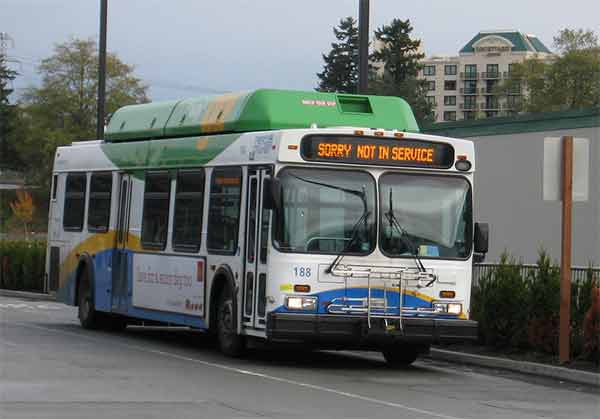
Pierce Transit Bus Seattle

The $1 low-income fare is soon coming to Pierce Transit as well. The Pierce Transit Board of Commissioners recently approved a proposal to finally join Seattle’s ORCA LIFT program for low-income fares. The unanimous vote extended Pierce Transit’s low-income fare services to all areas that use ORCA with the exception of Washington State Ferries. ORCA LIFT fare for Pierce Transit will just be $1.

Other transport companies currently running the program include Sound Transit Services, King County Metro, Everett Transit, Kitsap Transit, Seattle Streetcar, and other intra-county ferries. Pierce Transit plans to start charging the $1 low-income fare starting from April 1, 2023.

The proposal was presented to the board by the senior planner at Pierce Transit, Lanai Tua. According to statistics, 2% of Pierce Transit users are riders who already carry the ORCA LIFT card since they frequently transfer between Sound Transit and Pierce Transit. In a recent poll, 88% of respondents supported PT’s change while just 2% opposed the idea.

Almost 30% of the respondents are already users of the ORCA LIFT program. There was only one public hearing testifier, Laura Svancarek who lives in Downtown-On-The-Go. She fully supported Pierce Transit’s decision to join the ORCA low-income fare program.

The low-income fare program has been gaining ground for some time now. The Sound Transit Board made a decision to make its $1 fares permanent at the end of January this year. This was after the company’s pilot program had reduced the low-income fare to a dollar.

The ORCA LIFT low-income fare has been welcomed by many across Seattle. You qualify for the low-income fare if you are aged between 19 and 64 and if your income falls under 200% of the federal poverty level. The qualification provides you with the chance to pay $1 in fare for a period of one year and can be renewed annually.

If you are above 65 years old, you are entitled to the Regional Reduced Fare Permit, which has the same low fares as the low-income fare program. Children and other riders below 19 years ride free because of the new state grants offered to transit. The grant is offered to every public transport company that accepts the ORCA LIFT program, except the Seattle Center Monorail which charges $1.75 for riders aged between 6 and 18.

The ORCA LIFT program was launched in 2015 by King County Metro, Seattle Streetcars, and Link Light Rail. The low-income fare program had been around for years. Kitsap Transit had been running its own low-income fare program from as far back as 1985. Kitsap Transit was used as a model for the ORCA LIFT program.

There are still other transit services that charge over $1 for low-income riders, such as Seattle King County Ferries, Community Transit, Seattle Center Monorail, and Kitsap fast Ferries for their westbound services.

Low-income fares are also not unique to Seattle. They are available in other cities including New York City, Miami, Dallas, Jacksonville, Columbus, Portland, Denver, Salt Lake City, San Francisco Bay Area, and Austin just to mention a few.

Photo is provided by Atomic Taco

1 3 4 5 6 7 38
Go to Top